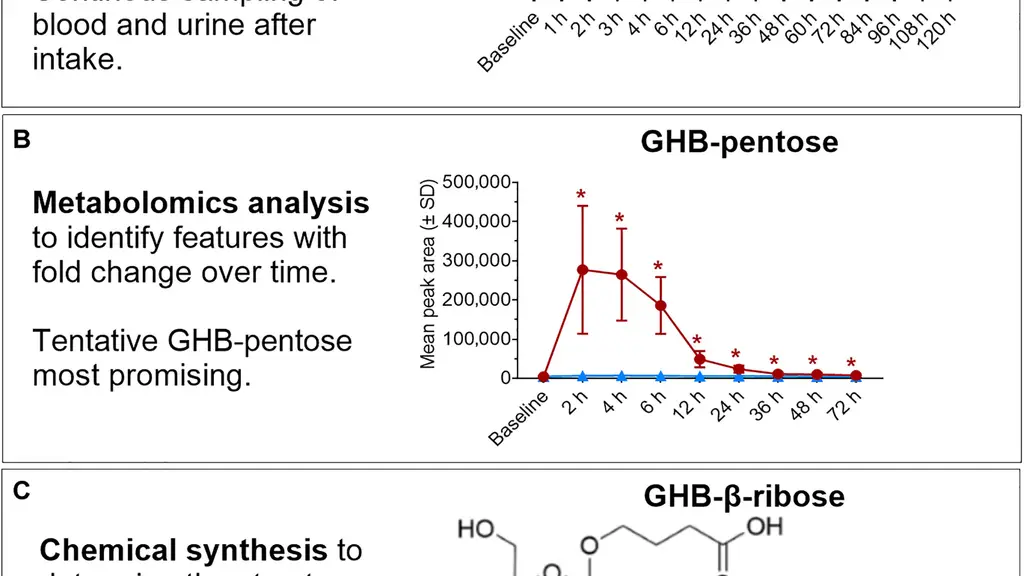
On November 25, researchers at Aarhus University in Denmark published findings on the molecular marker in Science Advances. A blood test for the marker could indicate gamma-hydroxybutyrate (GHB) use up to 48 hours after ingestion. The clinical trial involved 30 people who received GHB or a placebo.
Source: Medical Xpress.
The marker was detectable in blood for up to 48 hours and in urine for up to 36 hours after GHB use. Previously, the drug could be detected in urine for no more than 12 hours.
The molecule was named GHB Beta Ribose. Chemists synthesized a molecule with the proposed structure and showed that it was identical to the previously unknown substance found in the clinical trial. They also found it in samples police collected from drivers under the influence of GHB.
GHB is eliminated from the body quickly, complicating investigations into its use, including in drug-facilitated crimes. The study authors say the new marker could extend the period in which GHB use can be confirmed.
The method needs further validation before it can be used in criminal proceedings. Researchers are investigating whether certain diseases or alcohol consumption affect biomarker levels in biological samples.