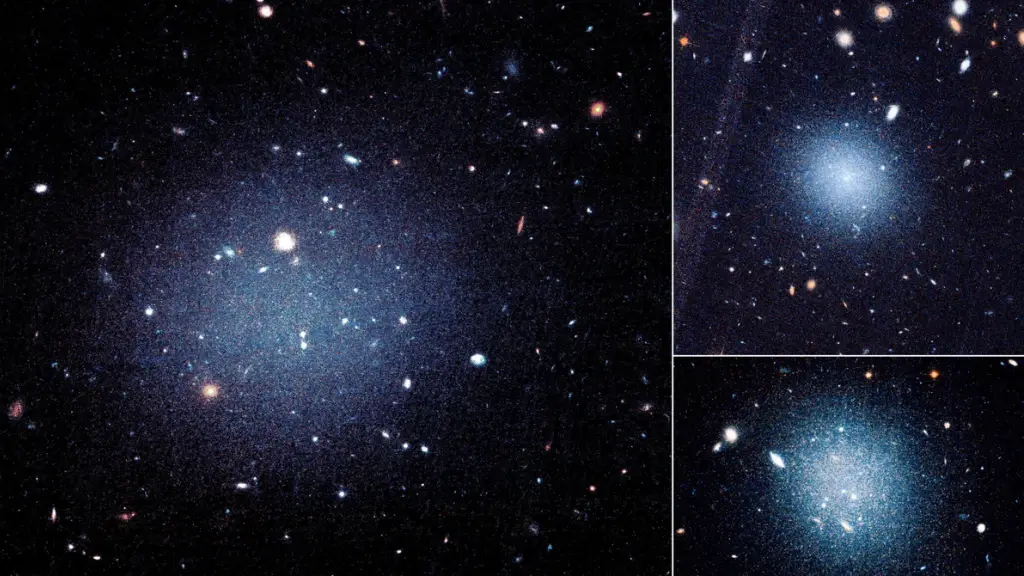
Three faint galaxies, DF2, DF4 and DF9, located about 65 million light-years from Earth, contain almost no dark matter. Quanta Magazine reported this in a story republished by Wired. Researchers estimated the galaxies’ masses from the motion of their stars and found that all three contain little dark matter.
Wired reported the news.
DF2 was discovered in 2018. Based on observations from the Keck Observatory in Hawaii, it is estimated to contain at most 400 times less dark matter than expected, making it the first galaxy with such a deficit. A similar galaxy, DF4, was recorded in 2019, while scientists announced DF9 in 2026. Its mass is about 100 million solar masses, which corresponds only to ordinary matter.
Michael Keim of Yale University and his colleagues propose an explanation: two ordinary galaxies collided head-on. Gas and dust clumped together, while dark matter, which interacts only through gravity, passed through them and kept going. This is described in a paper published in June 2026 in The Astrophysical Journal.
An analogy would be two knights jousting, where the knights and their lances collide and may be thrown to the ground in a heap, while their horses keep on running at full speed.
Aaron Romanowsky, astronomer at San Jose State University
Not everyone agrees with this scenario. Theoretical astrophysicist Kinwah Wu of University College London notes that the trio lacks the fluid, wispy features one would expect after a galactic collision. He suggests the galaxies passed through a large group of massive galaxies, which stripped them of their dark matter. Astronomer Stacy McGaugh of Case Western Reserve University believes the origin remains unresolved.
Most experts quoted by Quanta Magazine argue that these galaxies contradict modified Newtonian dynamics (MOND), an alternative to dark matter proposed by physicist Mordehai Milgrom in 1983. Theoretical physicist Shyam Balaji of King’s College London believes it is easier to remove matter than to change a law of nature.
I think it’s fine and healthy to have alternative theories and open debate. But let’s also be frank about whether the theory fits the data. MOND does not.
Daniel Whiteson, particle physicist at the University of California, Irvine
The nature of dark matter is still unknown: it has not yet been detected directly. Candidates include a stealthy type of neutrino, weakly interacting massive particles (WIMPs), and even primordial black holes.