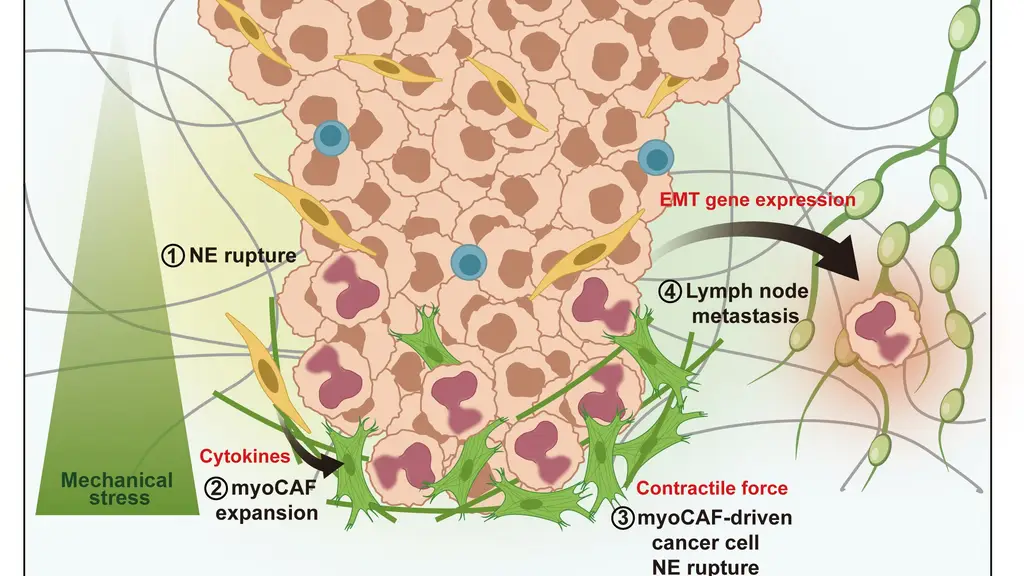
The Korea Advanced Institute of Science and Technology (KAIST) announced the findings Nov. 22. Teams from KAIST and Gangnam Severance Hospital at Yonsei University transplanted melanoma cells into mice’s footpads and repeatedly applied mechanical stimulation. The study was published Oct. 20 in Cancer Research.
Source: Medical Xpress.
In mice, repeated stimulation was accompanied by increased melanoma metastasis to the lymph nodes and a reduced response to immunotherapy. In patient samples, tumors in high-pressure areas were more often associated with changes in surrounding tissues and lymph node metastases. This association alone does not show that pressure caused the metastasis.
After stimulation, tissues contained more contractile myofibroblasts marked by LRRC15. These changes were most pronounced at the edges of tumors exposed to greater stimulation.
The researchers found that myofibroblasts contributed to damage to the cancer cells’ nuclear envelopes. Genetically destabilizing the envelopes also changed surrounding cells. The researchers said the findings point to a possible cycle of reciprocal influence between cancer cells and surrounding tissues.
In patient samples, these changes were not directly associated with overall survival. The study did not develop a treatment to interrupt this cycle. Further research is needed to determine whether the findings could help limit metastasis or improve patient treatment outcomes.