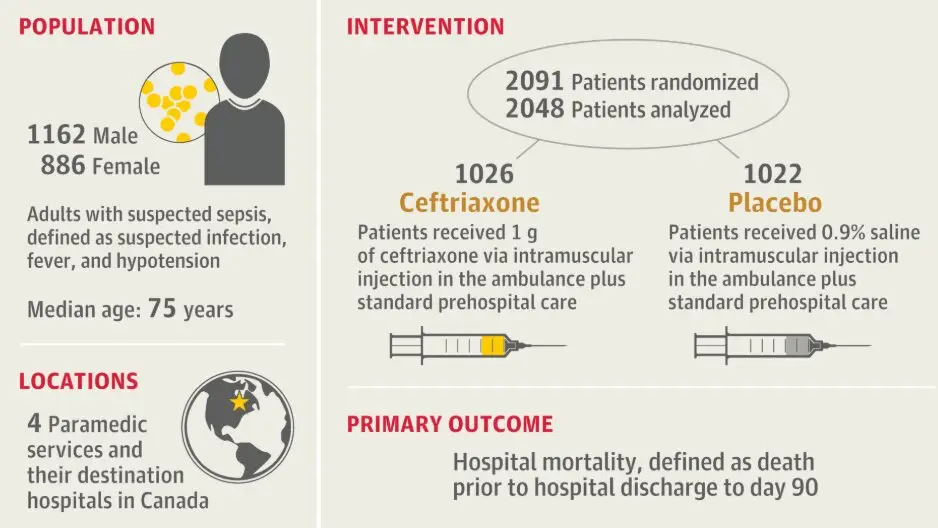
Canadian researchers conducted a randomized trial of 2,048 patients with suspected sepsis across four paramedic services and hospitals in Ontario. An injection of ceftriaxone in the ambulance did not reduce 90-day in-hospital mortality compared with placebo. After arriving at the emergency department, all participants received standard care, including intravenous antibiotics.
Medical Xpress published the report.
Participants were randomly assigned to two groups: one received an injection of ceftriaxone and the other a placebo. Suspected sepsis was defined by suspected infection, fever and low blood pressure. The results were published in the Journal of the American Medical Association (JAMA).
The 90-day in-hospital mortality rate was 18.0% in the ceftriaxone group and 18.4% in the placebo group. The mean time from the paramedics’ arrival to administration of an intravenous antibiotic was 201 minutes in the first group and 207 minutes in the second.
In the ceftriaxone group, the injection was given within 37 minutes of the paramedics’ arrival. More than three hours after the paramedics arrived, 92.5% of participants in that group and 92.2% in the placebo group had received an intravenous antibiotic in the hospital.
The study authors noted that patients received antibiotics in the ambulance an average of three hours earlier than under usual hospital care. However, outcomes did not differ.