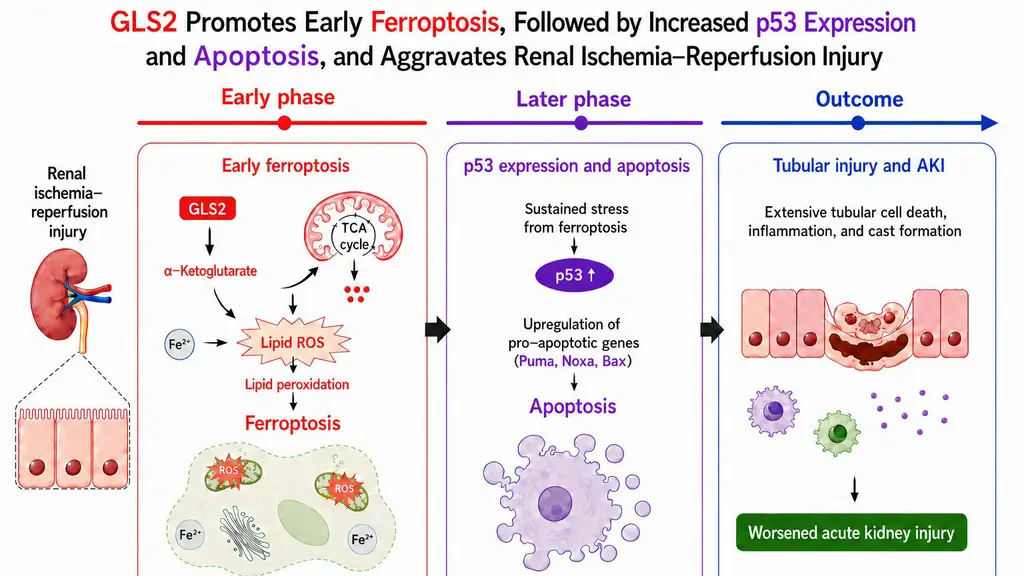
Researchers at Chiba University in Japan found that the enzyme glutaminase 2 (GLS2) contributes to kidney injury in mice after ischemia–reperfusion. The study was published in Free Radical Biology and Medicine.
This was reported by Medical Xpress.
Mice lacking the Gls2 gene had less kidney tubular damage after ischemia–reperfusion than control animals. Treatment with ferroptosis and glutaminase inhibitors also reduced cell death and kidney damage in mice.
Experiments with cultured kidney cells showed that GLS2 promotes ferroptosis through alpha-ketoglutarate-dependent lipid peroxidation. In this process, reactive oxygen species react with fats in cell membranes and produce lipid peroxides that can damage cells.
At a later stage, cells with GLS2 showed more apoptosis, or programmed cell death, and higher p53 expression. The researchers concluded that early ferroptosis may contribute to subsequent apoptosis.
The researchers applied a glutaminase inhibitor to surgical gauze and placed it directly on the kidney during ischemia. They said the method could be adapted for procedures with a foreseeable risk of ischemia–reperfusion, including kidney transplantation.
In publicly available datasets, the researchers also found increased expression of GLS2 and the PTGS2 gene in human kidney tissue after ischemia–reperfusion. The main experiments were conducted in mice and cultured cells; the approach’s effectiveness and safety in people still need to be assessed.
Ischemia–reperfusion can occur during kidney transplantation or some surgical procedures. It is a major cause of acute kidney injury and can increase the risk of long-term complications, including chronic kidney disease.
The researchers plan to develop approaches targeting GLS2 or ferroptosis for procedures in which the risk of kidney injury can be anticipated.