On November 5, the U.S. Food and Drug Administration (FDA) granted accelerated approval to amivantamab for metastatic HPV-negative head and neck squamous cell carcinoma. It is the first new drug approved for this type of cancer in seven years.
Medical Xpress reported the news.
Amivantamab targets both the epidermal growth factor receptor (EGFR) and the mesenchymal-epithelial transition (MET) receptor. The approach is designed to limit adaptive resistance, in which cancer cells compensate for the blocking of one signaling pathway by increasing activity in another.
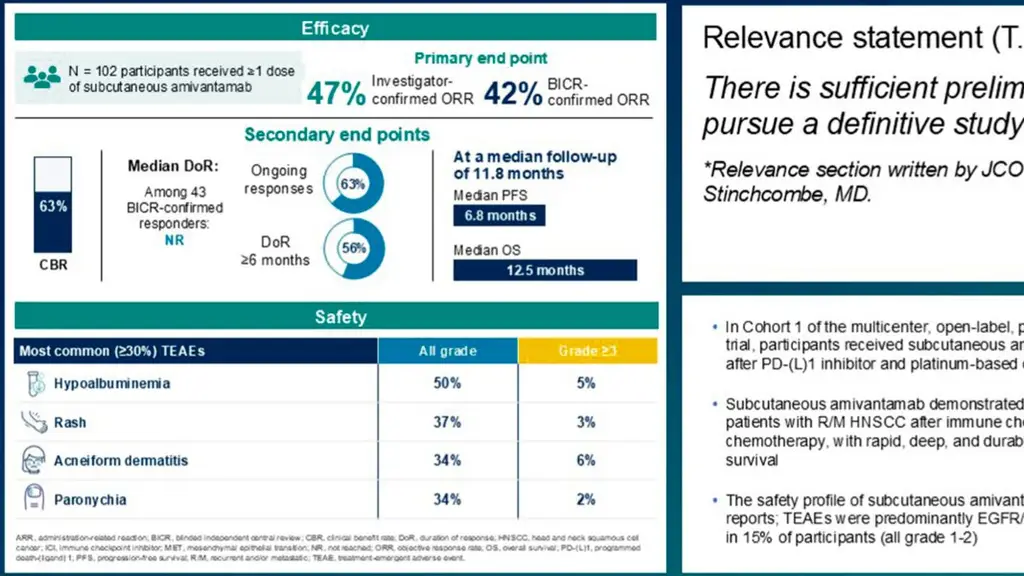
The phase Ib/II trial included 102 patients with HPV-unrelated head and neck cancer. All had previously received chemotherapy and immunotherapy. According to the trial’s lead investigator, Barbara Burtness of Yale School of Medicine, 42% of participants had an objective response to treatment, and median survival was 12.5 months.
The drug is given as a subcutaneous injection. The main side effects included rash and reduced albumin levels, the investigator said. Infusion reactions occurred in 15% of participants and were mild, she said.
The trial results were published in the Journal of Clinical Oncology. A study testing amivantamab in combination with chemotherapy and immunotherapy is ongoing.