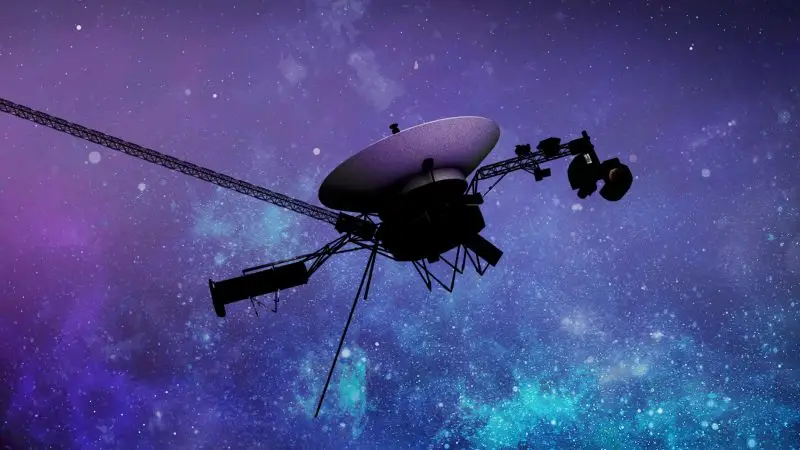
NASA detected a problem with Voyager 1 on November 14. The probe stopped transmitting science and engineering data and is about 26 billion kilometers (16 billion miles) from Earth.
This was reported by the news site CNN.
Using the carrier signal and trajectory calculations, engineers confirmed Voyager 1 had reached a distance of one light-day. That is how far a radio signal travels in 24 hours, or about 26 billion kilometers (16 billion miles). The problem was detected five days before the milestone was scheduled to be marked.
According to NASA, the carrier signal indicates that the navigation computer is keeping the spacecraft pointed toward Earth and that its antenna and broadcasting equipment are working. The lack of data could point to a problem with the onboard computer that collects information from the scientific instruments.
Only two of Voyager 1’s 10 instruments are operating; the rest have been turned off to conserve power. The mission team is working to resolve the problem.
A NASA spokesperson said the issue is ongoing but provided no further details.
In late October, Voyager 1 lost all communication with Earth for two days. The problem resolved on its own, and NASA is investigating whether that incident may be connected to the current interruption in data transmission.
A similar problem occurred on November 14, 2023, when Voyager 1 also stopped sending science data. NASA traced the issue to the flight data subsystem, or FDS, which collects and prepares data for transmission. NASA has not confirmed whether the current problem is related to the FDS.
Voyager 1 launched in September 1977, and its twin, Voyager 2, launched in late August of the same year. Both spacecraft are exploring interstellar space. Voyager 1 left the heliosphere in 2012 and Voyager 2 in 2018; the heliosphere is a protective bubble created by the sun’s magnetic field.