
Medicine & Research

  1. Medicine & Research

    Rio de Janeiro reports 180 mpox cases in two months

    Brazil has seen an increase in mpox cases, with clade Ib found in samples. Two clinical trials found no evidence that tecovirimat speeds lesion resolution.

    Rio de Janeiro reports 180 mpox cases in two months
    Photo: Medical Xpress

    Rio de Janeiro city confirmed 180 mpox cases from October 1 through November 24.

    Original report: Medical Xpress.

    São Paulo state recorded 128 cases from October 1 through November 17. Brazil had 1,429 confirmed cases and one death as of November 23.

    At the Fiocruz National Institute of Infectious Diseases in Rio, researchers analyzed 62 samples from September and October: 43 were clade Ib and 19 were clade IIb. The 2022 outbreak was caused by clade IIb.

    A trial in the Democratic Republic of Congo included 597 patients with clade I, assigned to receive tecovirimat or a placebo. In April 2025, lesions cleared in seven days in the drug group and eight days in the placebo group; the difference was not statistically significant.

    In February, a second trial included more than 400 adults with clade II. By day 29, the estimated proportion whose lesions had cleared was 83% among those who received the drug and 84% among those who received a placebo. The study found no evidence that tecovirimat speeds lesion resolution in adults with clade II mpox.

    Brazil increased its order of mpox vaccine to 25,000 doses, with distribution scheduled to begin November 23. Vaccination was limited to designated groups: people living with human immunodeficiency virus (HIV) and users of HIV preexposure prophylaxis (PrEP).

    The groups also include laboratory workers who handle the virus and medium- or high-risk contacts of confirmed cases. There are no plans for mass vaccination; shots are given at immunization reference centers rather than primary care facilities.

    The Ministry of Health is urging people with new skin lesions, especially those with a fever or swollen lymph nodes, to seek medical care and avoid close physical contact until they are evaluated. It also urges people with HIV to keep their antiretroviral therapy up to date.

  2. Medicine & Research updated 23:54

    Ambulance ceftriaxone did not reduce deaths in suspected sepsis trial

    In a trial of 2,048 patients, ceftriaxone was given about three hours earlier than antibiotics are typically administered in the hospital.

    Ambulance ceftriaxone did not reduce deaths in suspected sepsis trial
    Photo: Medical Xpress

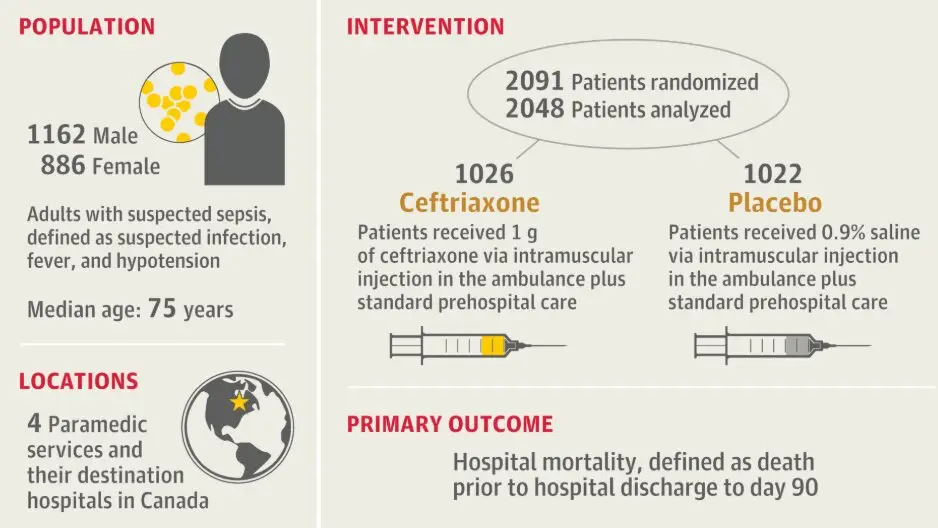
    Canadian researchers conducted a randomized trial of 2,048 patients with suspected sepsis across four paramedic services and hospitals in Ontario. An injection of ceftriaxone in the ambulance did not reduce 90-day in-hospital mortality compared with placebo. After arriving at the emergency department, all participants received standard care, including intravenous antibiotics.

    Medical Xpress published the report.

    Participants were randomly assigned to two groups: one received an injection of ceftriaxone and the other a placebo. Suspected sepsis was defined by suspected infection, fever and low blood pressure. The results were published in the Journal of the American Medical Association (JAMA).

    The 90-day in-hospital mortality rate was 18.0% in the ceftriaxone group and 18.4% in the placebo group. The mean time from the paramedics’ arrival to administration of an intravenous antibiotic was 201 minutes in the first group and 207 minutes in the second.

    In the ceftriaxone group, the injection was given within 37 minutes of the paramedics’ arrival. More than three hours after the paramedics arrived, 92.5% of participants in that group and 92.2% in the placebo group had received an intravenous antibiotic in the hospital.

    The study authors noted that patients received antibiotics in the ambulance an average of three hours earlier than under usual hospital care. However, outcomes did not differ.

  3. Medicine & Research updated 23:54

    Study links higher BMI to more severe perimenopause symptoms

    An international study of nearly 2,000 women also found symptom burden was associated with mental health, smoking and socioeconomic factors.

    Study links higher BMI to more severe perimenopause symptoms
    Photo: Medical Xpress

    Results of a global cross-sectional study of nearly 2,000 perimenopausal women were published November 25 in Menopause. Using data collected through the Flo app, researchers found that higher body mass index (BMI) was associated with more severe symptoms, particularly physical ones.

    Details were published by Medical Xpress.

    The researchers’ models accounted for age, race and ethnicity, income, education, smoking, physical activity, alcohol use, anxiety, depression and diabetes. Higher BMI was independently associated with more severe symptoms, including hot flashes and night sweats.

    Anxiety and depression were the strongest independent predictors of symptom burden, regardless of BMI category. Insufficient income, lower educational attainment and smoking were also associated with symptom burden, while more frequent physical activity was linked to less severe symptoms.

    In this large global study, higher BMI was associated with greater overall symptom burden, particularly physical symptoms, but weight was only part of the picture.

    Dr. Stephanie Faubion, medical director for The Menopause Society and one of the study authors

    Faubion emphasized the need for a comprehensive, individualized approach to women in perimenopause and for long-term studies to determine whether changing these factors improves symptoms.

    Perimenopause is the natural transition leading to the final menstrual period. The study authors say hormonal fluctuations and metabolic changes may interact with BMI.

  4. Medicine & Research updated 23:54

    Researchers identify how metal particles may inflame airways

    Scientists identified a cellular receptor through which particles may worsen asthma symptoms. In laboratory studies, drugs that block the receptor prevented these effects, but using them to prevent asthma is still under consideration.

    Researchers identify how metal particles may inflame airways
    Photo: Medical Xpress

    Researchers from King’s College London and Cardiff University published a study in eBioMedicine on how metal particles in air pollution may cause airway inflammation. The work used laboratory models and population health data, and examined human lung tissue and cells.

    More details are available from Medical Xpress.

    The team also analyzed health and environmental data collected over time. Exposure to metals in air pollution was linked to severe asthma attacks. The authors suggest that monitoring metal levels in the air could help identify periods of increased risk for people with asthma.

    In studies of human lung tissue and cells, the researchers examined the calcium-sensing receptor (CaSR). Their findings showed that air pollution particles activated it, increasing inflammation and making the airways more sensitive and prone to narrowing.

    In laboratory studies, existing drugs that block CaSR prevented these effects. The researchers say the drugs could potentially be used for people whose asthma is worsened by air pollution. Their use to prevent attacks still needs to be tested.

    Researchers from Imperial College London and Queen Mary University of London also contributed to the work. Clinical trials of drugs that act on CaSR are already underway for other conditions, but in this study the drugs were investigated in the laboratory.

  5. Medicine & Research

    Review finds unhealthy food promoted more heavily on delivery apps

    The authors urge governments to regulate the platforms, including by limiting junk food promotions and making recommendation algorithms more transparent.

    Review finds unhealthy food promoted more heavily on delivery apps
    Photo: Medical Xpress

    Researchers from Edith Cowan University and Deakin University reviewed how online food delivery platforms affect diet, physical activity, the environment, work practices and policy gaps. The review was published in Current Obesity Reports.

    The report comes from Medical Xpress.

    The review found that unhealthy foods dominate delivery apps and are promoted more heavily than healthier alternatives. Platforms also use personalized recommendations, algorithm-driven rankings, discounts, combo deals and other digital tactics to encourage customers to spend more.

    Proposed measures include mandatory kilojoule labeling and tighter restrictions on junk food promotions. The authors also recommend greater transparency around recommendation algorithms and offering healthier meals by default.

    The review’s lead author is Adyya Gupta, a senior research fellow within the Food Environments Team at Edith Cowan University’s Nutrition and Health Innovation Research Institute.

    Gupta said the apps increasingly shape people’s everyday food choices, rather than simply making ordering more convenient.