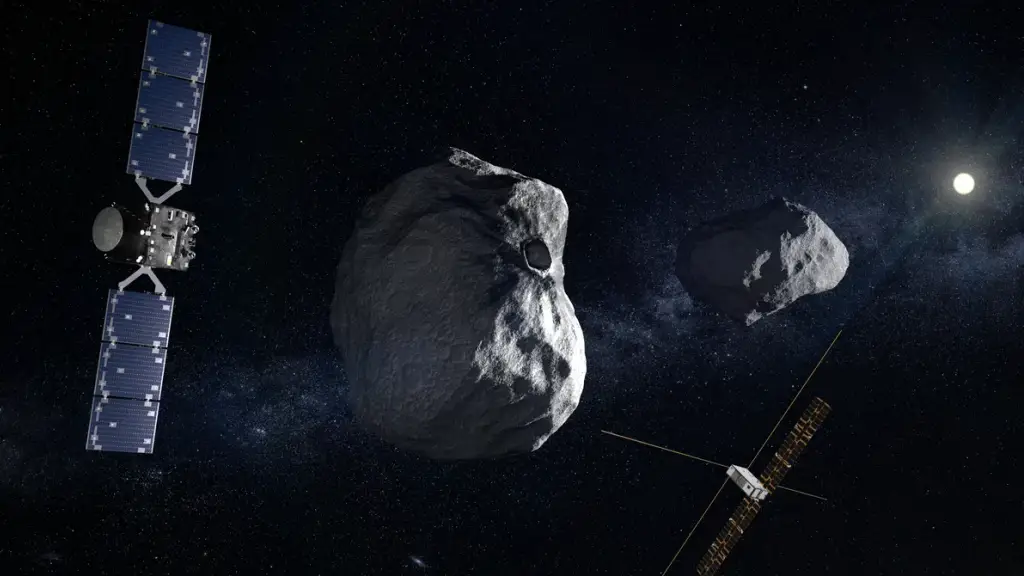
The European Space Agency’s Hera probe began its arrival phase at the asteroids Didymos and Dimorphos in October. The first detailed image of Didymos was published in early November.
More details are available from Wired.
Hera will study both asteroids up close, including the site where the DART probe struck. It will determine Dimorphos’ exact mass and examine the surface’s topography and chemical composition. Detailed images are expected to have a resolution of 1 meter per pixel.
NASA launched the DART mission in late 2021, and the probe collided with Dimorphos nearly a year later. The impact shortened Dimorphos’ orbital period around Didymos by 33 minutes. Ejected debris produced a stronger recoil than the impact itself.
Hera is carrying two small satellites, Juventas and Milani. They are scheduled to attempt to land on the asteroids’ surface in January 2027.
Juventas will study Dimorphos with radar capable of probing to a depth of up to 100 meters. Milani will examine the asteroids’ surface composition and search for traces of dust and volatile substances.
One of Hera’s goals is to find out how binary asteroids form. Didymos rotates once every 2.3 hours, putting it close to the limit of stability.
Under current plans, the mission’s main phase will last until the summer of 2027. Hera’s data will help assess DART’s effectiveness as a test of asteroid deflection technology.