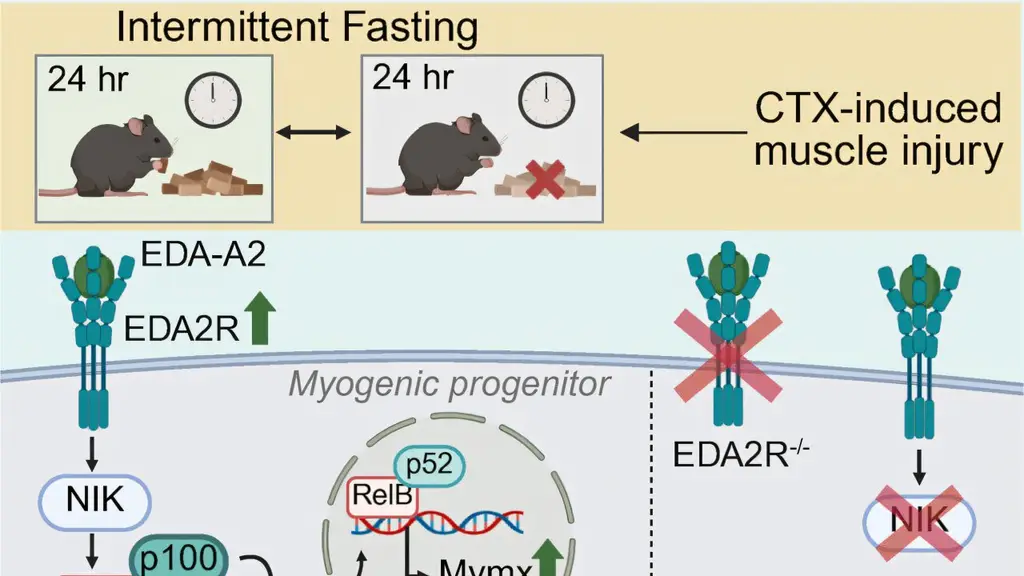
Researchers at Koç University in Istanbul published the findings in Cell Reports. They studied muscle recovery in young adult male mice after toxin-induced injury.
This was reported by the news site Medical Xpress.
The mice alternated 24 hours without food with 24 hours of unrestricted feeding; a control group had continuous access to food. After 10 days, injured muscles in the fasting group had gained more weight than those in the control group.
The fasting mice also had larger regenerating muscle fibers. Researchers found that more nuclei from newly formed cells had become incorporated into the fibers.
The additional benefit was linked to the EDA2R–NIK–Myomixer signaling pathway. Mice without EDA2R, or without NIK in satellite cells and their descendants, did not gain an extra benefit from intermittent fasting, although their muscles still regenerated.
Earlier research by the same team found that this pathway contributed to muscle loss in mice with tumors. The authors suggest that brief activation of the pathway during recovery may have a different effect from prolonged activation.
The authors suggest that short fasting cycles may encourage myogenic cells to fuse, while periods of refeeding provide the energy and nutrients needed for the process.
In a separate experiment using a mouse model of Duchenne muscular dystrophy, results were mixed. Fasting increased signs of regeneration and improved grip strength relative to body weight in two of four weekly assessments. However, the mice ate less and grew more slowly, making the results harder to assess.
The study did not establish whether the larger fibers produced greater strength, and it does not show that fasting improves muscle recovery in people.
The authors suggest that it may be possible to activate repair signals without restricting food. Doing so would require a way to stimulate regeneration while avoiding muscle loss associated with prolonged activation of the same pathway.