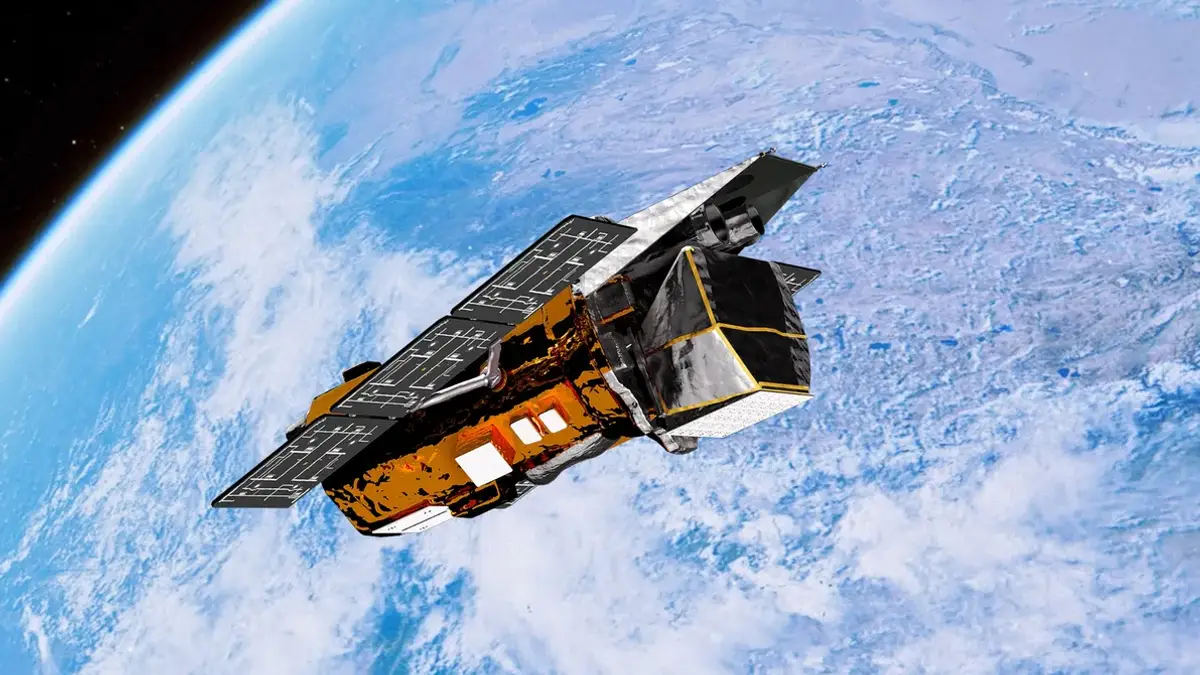
NASA’s Neil Gehrels Swift Observatory completed a scientific mission that lasted nearly 22 years. It made its final observation on October 20 and reentered the atmosphere over North Sumatra, Indonesia, on November 4, after its orbit fell below 275 kilometers.
More details are available from Wired.
Swift launched on November 20, 2004, to study gamma-ray bursts. The observatory could quickly pinpoint their locations, relay coordinates to other telescopes and observe their afterglows.
During its mission, Swift observed more than 2,000 gamma-ray bursts and more than 1,400 supernovae, and recorded black holes tearing stars apart. Its data contributed to about 7,000 scientific papers.
In May 2005, Swift detected the afterglow of the short gamma-ray burst GRB 050509B, which lasted 0.03 second. The telescope detected 11 x-ray photons. The observation supported theoretical models that short bursts are most likely caused by the merger of two neutron stars.
Swift’s orbit declined because of drag from the upper atmosphere, and the spacecraft had no thrusters to maintain it. In September 2025, NASA signed a $30 million contract with Katalyst Space Technologies to study the feasibility of providing services in orbit.
The LINK satellite launched on July 3 to capture Swift and raise its orbit. After a malfunction in its attitude-control system, NASA and Katalyst canceled the operation on August 19 and redefined the mission as an in-orbit demonstration.
LINK approached Swift to within 12 to 15 kilometers, but NASA said the satellite would not move closer. LINK reentered Earth’s atmosphere on September 25.
On August 26, the team resumed operations of Swift’s telescopes and photographed Tycho’s supernova remnant, about 13,000 light-years away. Once the orbit fell below 275 kilometers, the telescope could no longer maintain a stable lock on its target.
The full dataset, including more than 1.5 million images in ultraviolet and visible light, is publicly available and amounts to about 12 terabytes. NASA is considering how to use and expand its fleet of space telescopes.
Swift delivered an incredible, lasting return on investment for the nation, designed for a two-year primary mission but productive for more than 10 times as long.
Sean Domagall-Goldman, Director of the Astrophysics Division at NASA headquarters