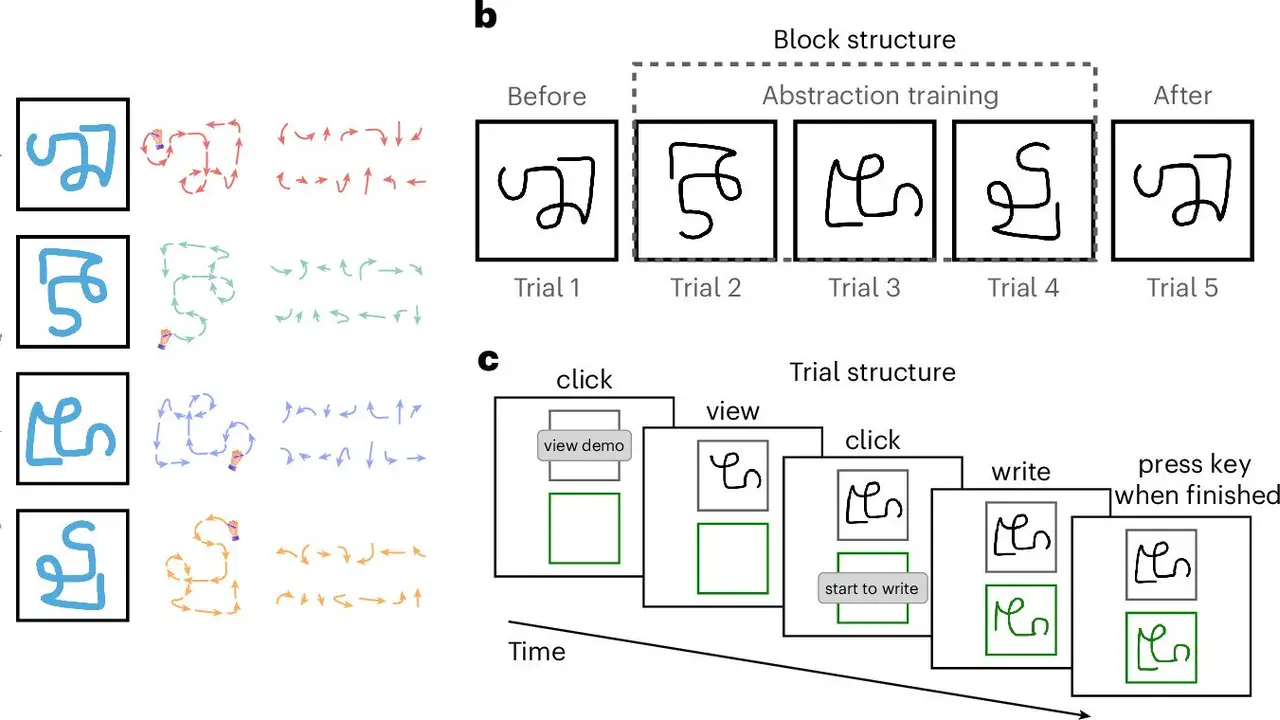
In 11 online experiments, Yale University researchers studied whether practicing a movement’s shared structure could improve new actions. The findings were published in Nature Human Behaviour.
Medical Xpress published the report.
Participants copied unfamiliar symbols using a mouse or trackpad. They then practiced drawing rotated versions of the symbols three times before copying the originals again.
Rotation changed the direction of hand movements but preserved the sequence of bends and turns. After this practice, participants improved in speed and accuracy about as much as those who repeatedly copied the original symbols.
Performance also improved when participants guided a dot along a set path without seeing the whole symbol. Moving along the path in reverse roughly halved subsequent gains, suggesting the sequence of actions mattered.
Researchers call the ability to preserve a movement’s essential structure across changing conditions motor abstraction. They suggest the principle could inform training in sports, music or rehabilitation.
In an accompanying briefing, the authors stressed that the experiments showed only immediate performance gains during short sessions. They did not establish how long the effect lasts or whether it helps people learn complex skills such as playing a musical instrument.