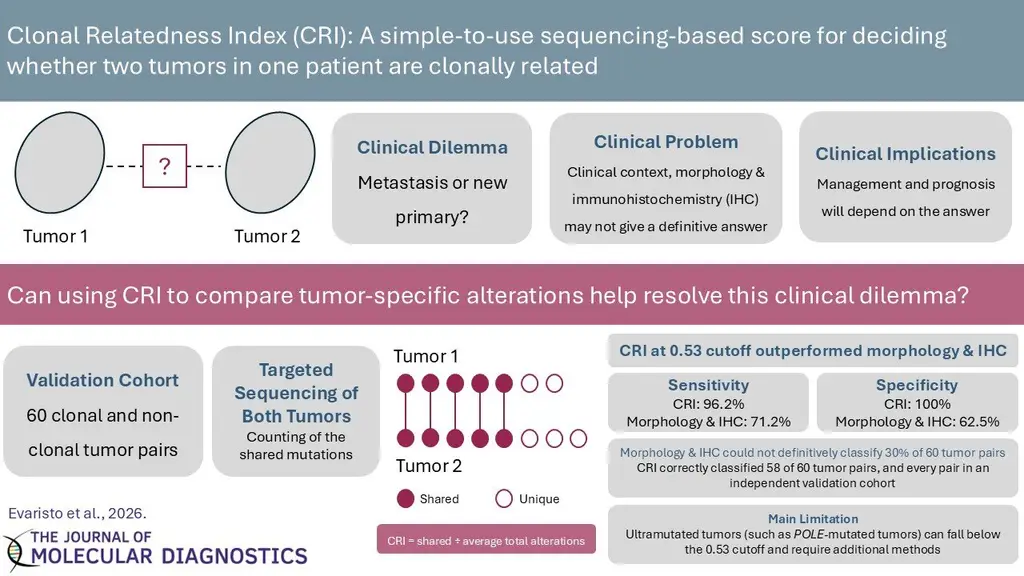
Researchers from the University of Chicago and McGill University analyzed 60 pairs of tumors from the digestive system, liver, pancreas, bile ducts and peritoneum. Their findings were published in The Journal of Molecular Diagnostics.
Original source — Medical Xpress.
The team used targeted next-generation sequencing data to develop the Clonal Relatedness Index (CRI). It is calculated by dividing the number of shared genomic alterations by the average number of alterations in the two tumors.
The researchers reported that CRI distinguished metastases from new, independent tumors better than assessment of tumor phenotype. The index was especially useful in difficult cases where similar features or a high mutational burden made tumor origin harder to determine.
In the validation group, the method failed for one tumor pair with an extremely high number of mutations and a mutation in the POLE gene. The authors urge particular caution in such cases.
The authors said more accurate classification could affect staging and treatment choices: mistaking a metastasis for an independent primary tumor, or vice versa, could lead to inappropriate treatment. The researchers did not assess clinical outcomes, and the effect of the index on treatment and patient health remains to be established.
The authors said the method needs further validation across different tumor types and sequencing platforms. Study lead author Namrata Setia works in the Department of Anatomic Pathology at the University of Chicago.