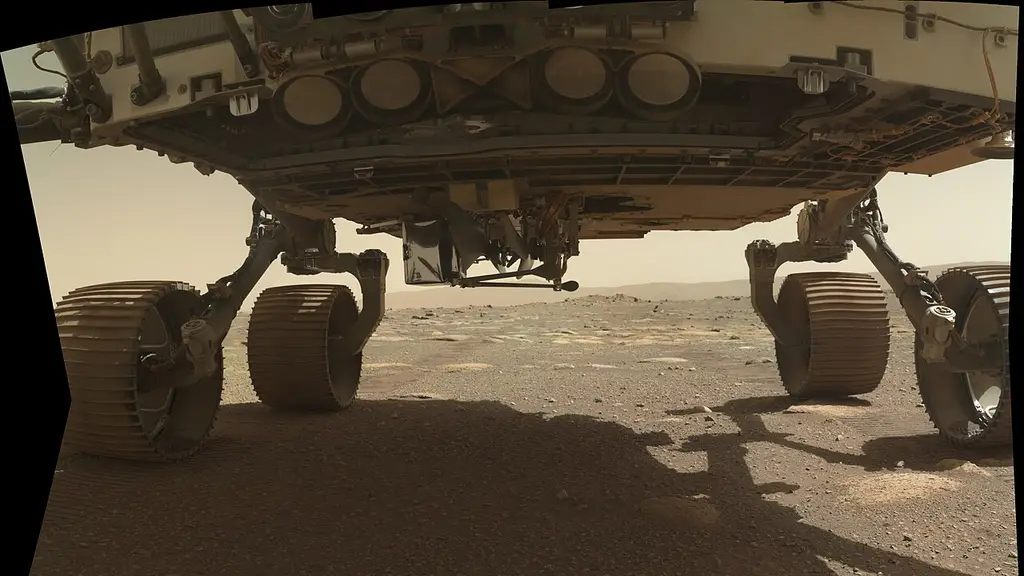
Two of NASA’s four spacecraft operating at Mars — the Perseverance rover and Odyssey orbiter — have paused science operations because of separate technical problems. On October 30, a Perseverance radio failed to respond when powered up. On Odyssey, a reaction wheel stopped spinning.
Details were published by Ars Technica.
When it powered up, one of Perseverance’s two ultra-high-frequency (UHF) radios did not respond. The rover automatically switched to its backup radio and entered safe mode. Ground teams later found that the backup radio was transmitting at about half its expected power, NASA said.
The team has stopped using both UHF radios while it assesses the possible causes of the problems and whether the radios can operate safely. Perseverance is sending signals directly to Earth in X-band, but at a much lower data rate than when communicating through orbiters.
Mission managers paused science operations as a precaution. They are first trying to get the backup radio working, then will turn to the primary radio.
After the latest failure, Odyssey has two working reaction wheels; another failed in 2013. The spacecraft needs at least three wheels to maintain the correct orientation. It now has to rely on hydrazine thrusters.
Without three working wheels, NASA estimates Odyssey has enough hydrazine for 1–2 months. Ground teams have made initial progress testing the malfunctioning wheel, but more tests are needed to determine whether it can be recovered.
Odyssey has been in orbit around Mars since 2001 and is the longest-lived mission at the planet in history. Perseverance is in its sixth year exploring the Martian surface; the rock and soil samples it has collected are intended for eventual return to Earth.